Work Clinical Interoperability · proprietary
Clinical-Trial Imaging Platform
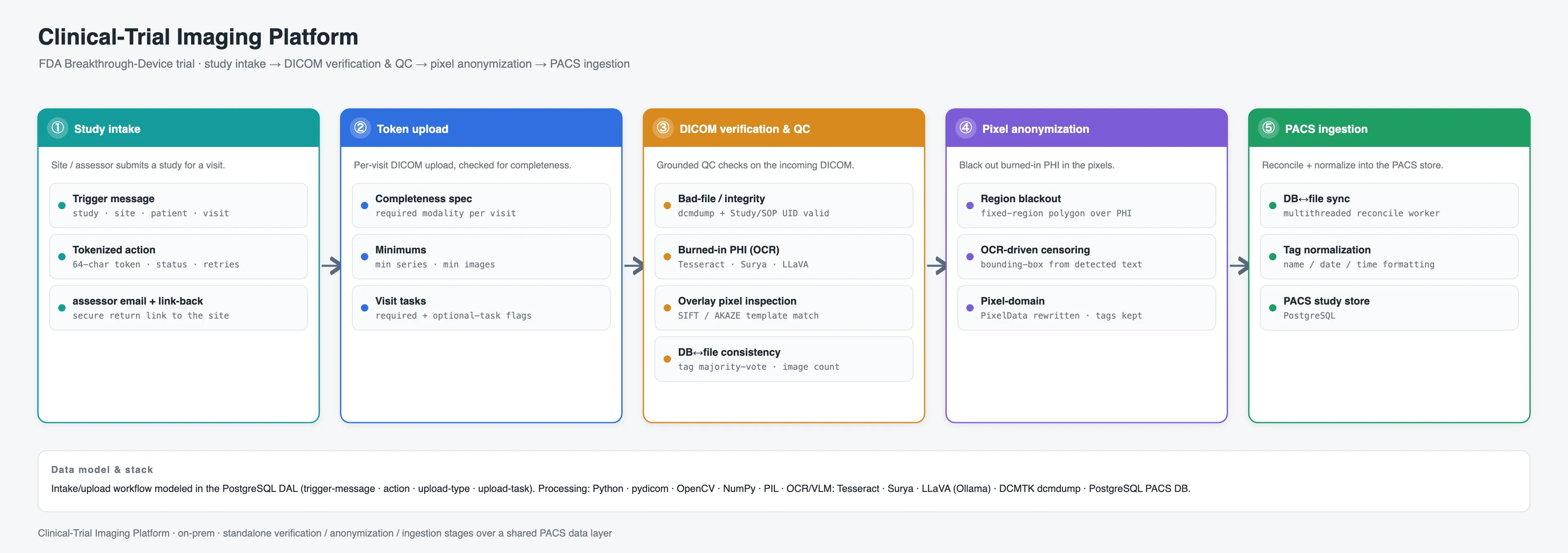
The production imaging pipeline for the Xeltis aXess FDA Breakthrough-Device trial — email intake, token uploads, five-phase DICOM verification, pixel anonymization, and PACS ingestion.
107
commits · primary author
5-phase
DICOM verification pipeline
FDA
Xeltis aXess Breakthrough Device trial
Problem
A multi-site FDA Breakthrough-Device cardiovascular trial needs imaging collected from many sites, verified, anonymized, and ingested — reliably, auditably, and without a coordinator hand-checking every study.
Architecture
An end-to-end pipeline from the trial’s email system to the PACS.
- Intake: IMAP monitoring parses trial emails (study, site, subject, visit, assessor) and de-duplicates on message ID.
- Token uploads: UUID tokens drive per-visit upload links to a web portal with a task checklist; chunked uploads assemble atomically.
- Five-phase verification: header validation against the trial metadata and a SOP-class whitelist; transfer-syntax decompression; pixel anonymization via a MIRC-CTP pipeline for burned-in annotations; form detection, overlay stripping, and metadata relabeling; then C-STORE ingestion with registration confirmation and series/image-count checks.
- Dashboard: a live admin view with per-task status, resend/cancel, and confirmation emails.
Results
In active production use for the Xeltis aXess™ trial — the first bioabsorbable cardiovascular conduit — as primary author across 107 commits.
Impact
Trial sites upload imaging through a guided, anonymizing, self-verifying pipeline instead of a manual back-and-forth — the boring infrastructure that makes a regulated trial run.